
India's current limit of $25 billion for ownership of government bonds by FIIs is fully utilised, leading to calls for increasing it
.JPG)
The Reserve Bank of India late on Wednesday unveiled rules to restrict how much its citizens and companies can invest abroad and announced additional curbs on gold imports.

Forex traders said a stronger dollar also dragged the rupee down.

The NSE Nifty after shuttling between 10,397.60 and 10,279.35 points, ended 47 points, or 0.45 per cent lower at 10,301.05.

Most say a rate cut could come in RBI's June policy.

Markets ended their lowest close in 2015 on fears of FII outflows as the US Fed may hike rates.

Rupee hits new low at close against dollar.

'Investors need to expect steady returns over the next one to two years with bouts of high volatility.'

Market breadth is positive with 942 advances and 196 declines.

The government plans to bring down its stake to 26 per cent in these two banks, which are yet to be identified. This may not come in the way of getting investors for these banks, provided the government is willing to step back rather than run them the way it had been doing for over five decades since these banks were nationalised, points out Tamal Bandyopadhyay.

Rupee weakened by 10 paise to end at 66.14 against the dollar due to month-end demand from importers and banks.


Most sought-after market of the past few years doesn't feature among top bets in Asia, emerging markets

The broader NSE Nifty moved between 10,705 and 10,785.55, before ending 25.15 points, or 0.23 per cent down at 10,716.55.

The unexpected upward revision of the country's sovereign rating by Fitch today will strengthen the battered rupee which would also stem the fund outflow from the domestic market, Standard Chartered said.

Foreign investors are betting top dollar on the country as growth is likely to recover at a time when other emerging markets are battling macroeconomic adjustments.
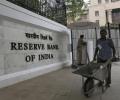
While RBI's foreign exchange reserves have swelled to over $400 billion, it has a 'sell' position of $981 billion.

Foreign portfolio investors (FPIs) and mutual funds (MFs) have put in more money as anchor investors in initial public offerings (IPOs) in 2021 than any other year. FPIs' share of investments for the year stood at Rs 24,477 crore, nearly six times that put in last year and more than nine times the amount invested in 2019, the data from Prime Database showed. MFs have invested Rs 12,264 crore, four times than that invested last year and more than 10 times the investment in 2019. The total investment by FPIs and MFs put together this year is five times the amount invested last year. The amount contributed by MFs, however, is nearly half of that invested by FPIs.

The 50-share NSE Nifty ended up 37.05 points, or 0.36 per cent, at 10,397.45 points

'MFs have a combined exposure of Rs 3.2 lakh crore to NBFCs, out of which Rs 1.1 lakh crore matures by September 2019.'

The NSE Nifty settled at 10,454.95, down 121.90 points, or 1.15 per cent.

Markets end in red; bluechips struggle to keep pace.

It has been a choppy calendar year 2022 (CY22) for global financial markets amid the spectre of rising inflation that led most central banks, especially the US Federal Reserve (US Fed), to tighten their monetary policy. Most equity indices across the globe have seen a sharp fall from their respective peak levels in this backdrop. FTSE India, for instance, has corrected 16 per cent from its October peak.

IPO market hopes to come out of slump in festive season, reports Sundar Sethuraman.

Since October, FPIs have sold over $26 billion worth of stocks, which is the largest selling ever seen in India, observes Akash Prakash.

India's current account slipped into a deficit of $9.6 billion or 1.3 per cent of GDP in the September quarter, the Reserve Bank said on Friday. The current account, which records the value of exports and imports of both goods and services along with international transfers of capital, was in a surplus mode both in the quarter-ago and year-ago periods. India's current account surplus had stood at $6.6 billion or 0.9 per cent of GDP in the April-June 2021 quarter, while in the year-ago period (Q2FY22), the surplus had stood at $15.3 billion or 2.4 per cent of the GDP, the data said.
.jpg)
On Wednesday, RBI reduced the cap on individual remittances abroad from $200,000 (about Rs 1.2 crore) to $75,000 (Rs 45 lakh) and also barred individuals from using funds under the scheme to buy immovable properties abroad.

The value of the foreign portfolio investors (FPI) holdings in the domestic equities reached $592 billion in three months ended June 2021, a surge of 7 per cent from the preceding quarter, according to a Morningstar report. This was largely on the back of robust net inflows from FPIs, coupled with the strong performance of the Indian equity markets. "As of the quarter ended June 2021, the value of FPI investments in Indian equities stood at $592 billion, which was considerably higher than the $552 billion recorded in the previous quarter, a spike of around 7 per cent," the report noted. As of June 2020, the value of FPI investments in Indian equities had been $344 billion.

The Securities and Exchange Board of India's (Sebi's) board on Wednesday allowed foreign portfolio investors (FPIs) to trade in exchange-traded commodity derivatives. The move, it said, "will enhance liquidity and market depth, as well as promote efficient price discovery." Overseas investors will only be allowed to deal in non-agricultural commodity derivatives and only cash-settled contracts.

The government's step could push investors to choose riskier equity, or to fall back on bank deposits, thereby negatively impacting the debt market which actually needs to grow, points out T N Ninan.

'The idea is to invest where there is opportunity.'

Despite a strong start to trade today, key benchmark indices retreated sharply from their higher levels following bouts of profit-taking amid fresh weakness in the rupee against the dollar.

The rupee fell back against the pound to 98.72 from overnight close of 98.48 and turned negative to end at 77.44 per euro from Rs 77.37.

The 50-stock NSE barometer Nifty finished 22.50 points, or 0.21 per cent, down at 10,526.20

The RBI governor is focused on growth, and keeping rupee slightly depreciated is part of that 'Atmanirbhar Bharat' strategy.

Forex dealers said besides robust month-end demand for the American currency from oil importers, dollar's strength against its rival currencies on expectations of rising interest rates amid lingering Sino-US trade tensions, weighed on the domestic currency.

Forex dealers said besides the dollar's gain against other currencies, fresh demand for the American unit from importers and a weak opening in the domestic equity market put pressure on the rupee.

The broader NSE Nifty struggled before ending well above the 10,500-mark.

Not just India, but Asian peers such as Indonesia, South Korea, Thailand, Taiwan and The Philippines have seen sharp FPI outflows this year

Sentiments took a hit after broader Asian markets weakened, following a renewed sell-off on Wall Street on Tuesday as energy shares dropped after crude oil prices plunged to a 13-month low amid weak earnings and US-China trade disputes, fuelling worries about economic growth
